No mission is done alone. Asking for help is a tactical decision, not a weakness.

After serving in the U.S. Army for nearly four years, Sonia Rivas figured she could handle anything.
Turns out, attending classes at Milwaukee Area Technical College has been a challenge.
“I thought school would be easier,” said Rivas, who enlisted fresh out of Golda Meir High School in Milwaukee. “Sometimes it seems to me that people here are speaking a different language. I’m still trying to find my way.”
For military veterans like Rivas, college can be difficult and daunting, but MATC offers plenty of resources and support to ensure that students who have served their nation succeed at college.
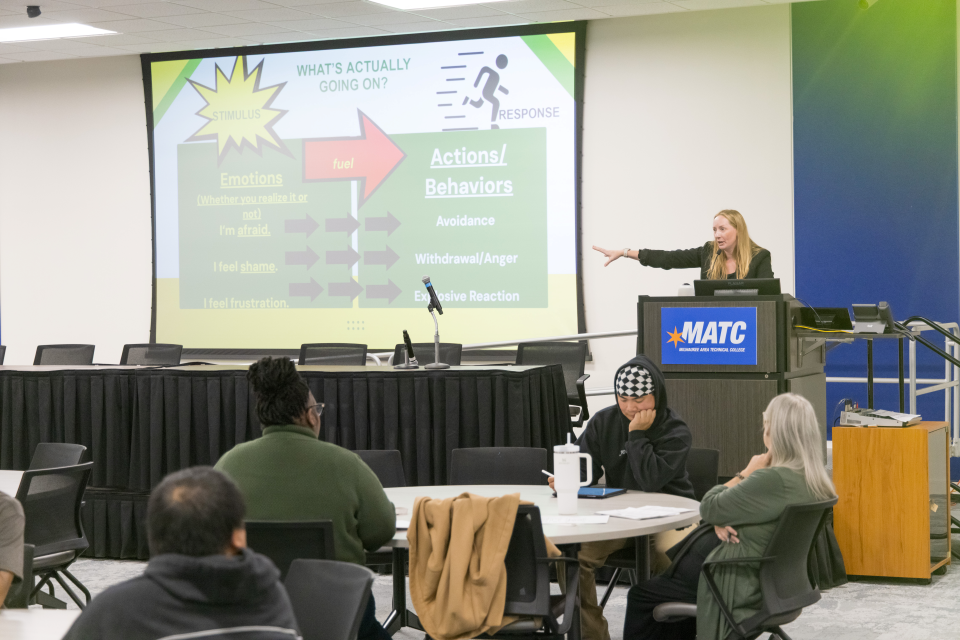
That was the message delivered Tuesday, October 20, at a workshop sponsored by the college’s Veterans Resource Center (VRC). At the session, faculty members and advisors offered ways for student veterans to complete their new mission — earning a college diploma or degree — through emotional resilience, resourcefulness, flexibility and teamwork.
“In the Marine Corps, we would say: improvise, adapt and overcome,” said Nicole Caselius, an instructor in the college’s Business and Management Academic and Career Pathway.
Veterans coming to college should embrace the discomfort of their new surroundings, Caselius said.
“Feeling out of place is growth under stress. Remember, you have already survived far harder conditions than college classrooms,” she said. “Start by knowing that you’re going to complete your mission, that you’re going to finish your degree. And no mission is done alone. Asking for help is a tactical decision, not a weakness.”
MATC offers veterans many forms of assistance: academic tutors, Counseling and Psychological Services (CAPS), the Military Education Support Office (MESO) and the VRC. The VRC serves students who are veterans or active-duty members and their dependents and spouses receiving military benefits, said Jamie Hollins Mast, student services specialist for veterans.
At the VRC, student veterans can get information and assistance for their educational and personal goals, participate in support groups, network, study, relieve stress, relax and reflect, Hollins Mast said.
Being good to yourself is a vital part of emotional resilience, said Samantha Burgos, a bilingual retention coach at the college, at Tuesday’s event. “You can acknowledge that you have survived every bad day of your life so far,” she said.
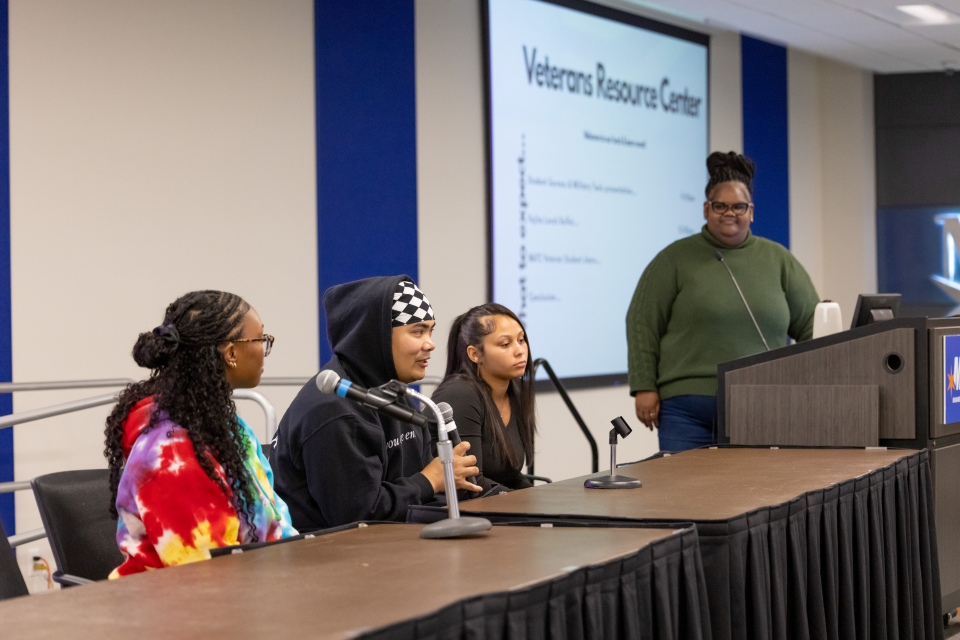
The event also featured a panel of student veterans, including Rivas, who shared their experiences of serving in the military, leaving and enrolling at MATC.
Rivas was a teenager when she joined the Army. “I was handed a rifle, was running obstacle courses and told to follow orders,” she recalled. “You learn perseverance. You find out you can do things you never thought you could do.”
She served as an information technology specialist before having a baby boy, now almost 2 years old. She decided to leave the military, but she had no plan.
“When I got out, I had no idea what I wanted to do,” Rivas said. “Getting out of the military with a baby was scary.” She is enrolled in MATC’s Health Information Technology program and is excited to graduate and start a new chapter of her life.
“I decided to put my family first. I am free of being told what to do all the time,” Rivas said. “I will be making all my own decisions.”
Jayla Pressley served in the U.S. Air Force and was stationed in Japan for three years. She left the service in April and this fall started in the Dental Hygiene program.
“I’m trying to unlearn who Sergeant Pressley was and find out who I am now,” Pressley said. “I’m trying to rediscover myself.”
Ace Rheaume spent 18 years in the U.S. Navy, left and enrolled in the Health Information Technology program. “For me, this is a complete break, a fresh break,” he said. “I’m still learning the tempo of this new life, but I’m excited for the future.”
He said much of his military training remains with him and has helped him on his new mission. “The good habits have stayed with me,” he said. “Being organized has helped me be successful in school.”
About MATC: Wisconsin’s largest technical college and one of the most diverse two-year institutions in the Midwest, Milwaukee Area Technical College is a key driver of southeastern Wisconsin’s economy and has provided innovative education in the region since 1912. More than 35,000 students per year attend the college’s four campuses and community-based sites or learn online. MATC offers affordable and accessible education and training opportunities that empower and transform lives in the community. The college offers more than 180 academic programs — many that prepare students for jobs immediately upon completion and others that provide transfer options leading to bachelor’s degrees with more than 45 four-year colleges and universities. Overwhelmingly, MATC graduates build careers and businesses in southeastern Wisconsin. The college is accredited by the Higher Learning Commission.