

UNDERSTANDING YOUR FINANCIAL AID OFFER
For students who have submitted their Free Application for Federal Student Aid (FAFSA), you will receive a financial aid offer. Once available, that financial aid offer can be viewed from the Financial Aid section of Self-Service. Your financial aid offer will list the different types of financial aid that you may be eligible to receive. Below we will describe the different sections of the financial aid offer and the different types of financial aid listed there.
WHAT IS YOUR COST OF ATTENDANCE?
The Cost of Attendance (COA) is the total estimated amount it will cost a student to attend MATC for the academic year. Your COA is also the "ceiling" for how much financial aid you can receive.
Why does COA matter?
- Budgeting: It helps students and families plan for both the bills they will receive from the college and the out-of-pocket expenses they’ll have throughout the year.
- Aid Eligibility: MATC’s Financial Aid Office will use the COA to calculate your "Financial Need."
Cost of Attendance - Student Aid Index (SAI) = Financial Need
Direct vs. Indirect Costs
An easy way to think about direct vs. indirect costs is what the student pays to MATC and what they should budget for costs outside of the college.
1. Direct Costs (The Billable Costs)
These are estimated charges that will appear on your tuition bill shown in Self-Service.
- Tuition: MATC bills you for each credit taken. Your initial financial aid offer estimates are based on full-time enrollment (12 credit hours).
- Fees (Students and Material): Charges for Stormer Pass, insurance, and digital access materials
2. Indirect Costs (The Estimated Costs)
These are estimated expenses a student will likely have while attending college, but they are not billed by MATC.
- Books & Supplies: Textbooks, lab materials, specialized software, or toolkits
- Transportation: Gas or parking passes
- Personal Expenses: Laundry, toiletries, clothing, and cell phone bills
- Food & Housing: Rent and groceries
AWARDS
Grants & Scholarships
Grants and scholarships are forms of financial aid that don’t have to be repaid (unless, for example, you withdraw from school and owe a refund).
If eligible, your initial Federal Pell Grant offered is calculated based on full-time enrollment (12 credits or more). The actual amount of Pell received will be adjusted based on the number of credits you are registered for and attend. You must attend each of your courses to be eligible for Pell funds for those credits. Those credits must also be part of the graduation requirements for your program. In addition to your enrolled credits, your eligibility for Pell is determined by the result of your FAFSA so the amounts are not the same for every student.
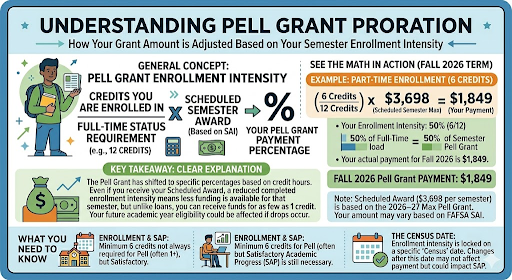
Example: Student is enrolled in 6 credits for the Fall 2026 term. (6 credits / 12 credits) x $3,698 = $1,849
Work Study
The Federal Work-Study (FWS) Program allows you to earn money to pay for school by working part-time. Your total work-study award depends on when you apply, your level of financial need, and funding availability. You must find a job through the CareerHub to earn those funds. If you’re interested in FWS, you may accept the award through Self-Service. If you received a financial aid offer, but FWS was not awarded, reach out to the Financial Aid Office at finaid@matc.edu to determine whether you may qualify.
Student Loans
A loan is money you borrow and must pay back with interest. If you apply for financial aid, you may be offered loans as part of your financial aid offer. When you receive a student loan, you are borrowing money to attend MATC. You must repay the loan as well as interest that accrues. It is important to understand your repayment options so you can successfully repay your loan.
Student loans may be accepted or declined. You are not required to take out any student loan offered to you. The Department of Education requires additional steps for first time student loan borrowers. Specifically, you must complete a Master Promissory Note (your promise to repay your loans) and Entrance Counseling (ensures you understand the commitment of taking a loan).
Important Updates for 2026-2027:
New Requirement: Per the One Big Beautiful Bill Act (OB3A), student loans must be prorated (reduced) if you are not taking a full-time courseload. THIS IS NEW!
How Loans Work
- Credit Load: Your loan amount is directly tied to your credit load. Taking fewer than 12 credits will reduce your loan amount accordingly.
- Initial Awarding: To stay compliant, MATC initially awards all student loans based on 6 credits (the minimum required for loan eligibility).
- First Week of Class: You can review your adjusted loan amount(s) in the Self-Service portal. You MUST reaccept to receive the loan funds.
- Withdrawals: If you withdraw from your courses during a semester, that may impact your ability to receive loans in a subsequent semester.
- Less than full-time formula for loan eligibility:
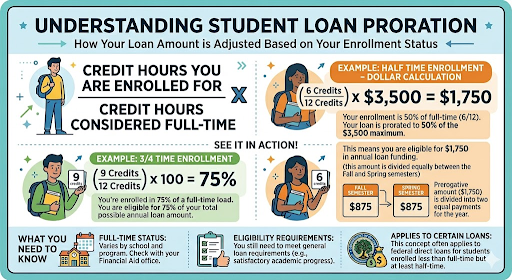
Example: Student is enrolled in 6 credits for the Fall 2026 term. (6 credits / 12 credits) x $3,500 = $1,750 (this amount is divided equally between the Fall and Spring semesters)
Net Price
Your net price is your total cost of attendance minus estimated financial aid offered. As your total cost of attendance includes indirect costs not paid to MATC, your actual amount due will be considerably less.
To view your total direct costs due to MATC, please see the Student Finance page on Self-Service. If you have a negative balance, you may be eligible to receive a refund from the college. See the Student Accounts Office for more details about setting up your BankMobile to receive your refund.
Question: How many credit hours do I need to be enrolled in to be considered a full-time student?
Answer: A minimum of 12 financial aid-eligible credit hours per term is considered full-time, which means 24 hours over the course of the fall and spring term is needed to be considered full-time during the academic year.
Question: How does being enrolled on a less-than-full-time basis impact my aid eligibility?
Answer: Both Federal Pell Grant and Federal Direct Student Loans are prorated if a student is taking fewer than 12 credits.
Question: What happens to my Federal Direct Student Loan if I withdraw from a class after my loan is disbursed?
Answer: When you withdraw from a class in the Fall, MATC must review your annual loan limit again. We use the total number of credits you actually completed in the Fall plus what you are enrolled in for the Spring. If you withdraw from a class in Fall, that course would not be considered completed. Withdrawing from a course could reduce or eliminate your eligibility for a loan in the Spring semester.