


MATC truly changed me. For me, the military was always so structured. MATC made me look at the world differently. It broadened things out for me.

When Richard Clark Jr. enters a room, he’s looking for an exit.
He immediately assesses the perimeter, seeks out weaknesses and determines the best place to retreat.
“I always need to know the way out,” he said.
It’s an instinct drilled into him by three decades of military training and service.
For many, serving in the armed forces means learning survival skills, growing stronger, becoming part of a team, and committing your body, mind and spirit to your country.
But for some, serving has caused stress, anxiety and depression. It has led to post-traumatic stress disorder (PTSD), social isolation, marital discord and in severe instances, homelessness or suicide.
Clark has been on both sides.
He served in the United States Army, the Wisconsin National Guard and the Army Reserves for a combined 33 years. He also experienced depression and underwent counseling for PTSD.
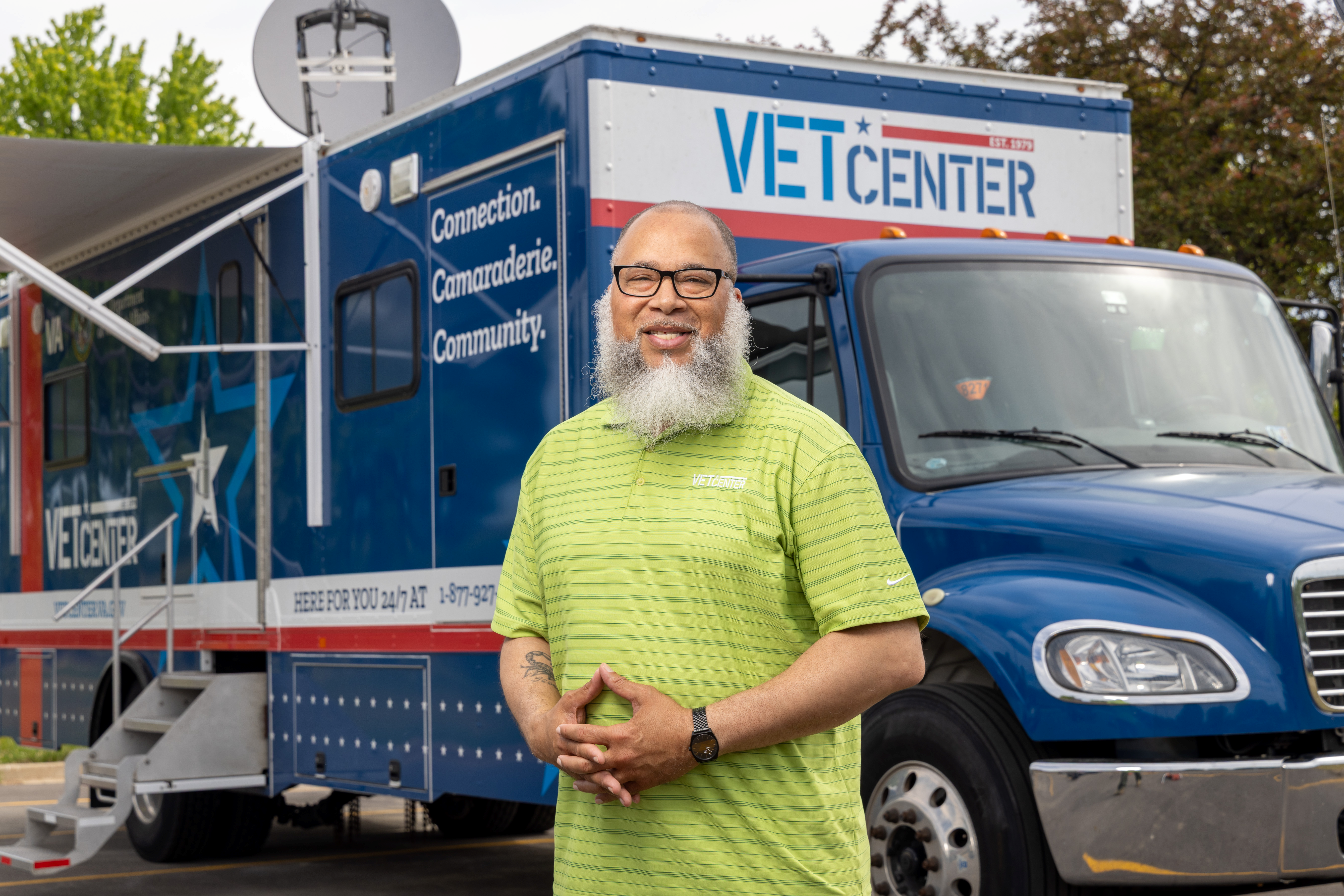
Since 2009, Clark, an MATC alumnus, has used his own experiences to assist area veterans as an outreach program specialist at the Milwaukee Vet Center. The center, operated by the federal Department of Veterans Affairs, provides eligible veterans, service members and their families with counseling and mental health services — services that Clark himself used.
“I always need to be mindful of my triggers. If I see it’s getting dark outside, I think rain is coming and I prepare for it,” said Clark, a heavily-built man with a long, wiry beard streaked with gray. “I think that everyone at some point goes through something.”
Clark’s something came while he was in the Army Reserve. In 2010, he went to Haiti to help the Caribbean island nation recover from an earthquake. In 2012, he was part of a humanitarian mission in Honduras called Beyond the Horizon.
“In Haiti, I watched them pull bodies out of the rubble. In Honduras, we saw the violence of the drug cartels right there in the streets,” Clark recalled. “I was supposed to be Superman tough during all of that. That’s the image I was supposed to display. But it messed me up.”
Clark found himself in a dilemma that has confronted many soldiers: How do I deal with all the confusion and pain?
“Twenty years ago they would say suck it up and drive on. You’re young and you hear that and you believe that,” he added. “Counseling was always there but frowned upon. It meant you were weak. If you did that, no one wanted you on their team. I’m coming to another man for help. What kind of man does that make me?”
A family tradition
Clark was born and raised in Milwaukee, immersed in the military. Both his father and mother served in the Army as combat medics. His father served two tours during the Vietnam War. Two uncles were in the Air Force. He remembers his family visiting them at several air force bases, hundreds of miles away from his inner city Milwaukee neighborhood.
“My cousins would leave their bikes outside, lying on the lawn,” Clark said. “I saw safety in the military.”
At home, he heard and saw how serving affected his family. “My mom always shared her stories about her service,” Clark said. “My dad was pretty tight-lipped until I left for basic training. I know he had nightmares. He would wake up in the middle of the night and want to go outside. My mom would tell us he had a rough night. Later, he became more vocal. He would talk about how hard it was to be saving lives one moment and taking lives another moment.”
Clark attended Milwaukee Public Schools and graduated from Milwaukee Madison High School in 1990. By that time, he had fathered two children and needed a job.
On Nov. 20, 1990, a few weeks after turning 19, he joined the Army. He served for seven years, working as an automation clerk. He left in 1997, and a few years later, joined the Wisconsin National Guard. He was set to leave the Guard, but the Sept. 11, 2001, terrorist attacks in New York and Washington, D.C., occurred and all military positions were frozen in place. From 2003 to 2005 he supported Operation Enduring Freedom, the first phase of the global war on terrorism, as a radio repairman.
In January 2005, he joined the Army Reserve and served until he retired in July 2023.
He originally thought about attending college in 1997, when he finished his stint in the Army. He finally got to MATC in 2007 and earned his associate degree in the Human Service Associate program two years later.
“I was trying to go to college, but the military kept pulling me back,” he said. “MATC was very flexible. They were always understanding about my drills and duties.
“I loved MATC,” Clark said. “The Human Service Associate program was great for me. I learned so much from my instructors. MATC truly changed me. For me, the military was always so structured. MATC made me look at the world differently. It broadened things out for me.”
Vet working with other vets
While finishing his associate degree, Clark interned at the Vet Center, located on South Washington Drive in Milwaukee. A few months after he graduated, he became the office manager. “I was the first person that the clients saw when they came in,” he said.
Today, he assists veterans from nine counties in the state. He makes presentations at businesses, distributes information and spreads the word about the center’s services. He’ll stop men and women in uniform and ask them how they are doing.
For veterans having a difficult time, communication is key, Clark said. He also knows all too well that deciding to talk to someone is usually the hardest step. When he started to struggle, he began attending group sessions at the Veterans Affairs Medical Center in Milwaukee.
“I felt I could blend in with a group,” Clark said. “But I didn’t like what I saw when I looked at myself and how I acted with others. That’s when I started individual counseling.”
At the Vet Center, veterans can openly and freely speak about what they are going through, Clark said. “No one wants to add PTSD to their career,” he said. “But there’s absolutely no judgment here.”
Once a veteran comes in for help, the Vet Center can bring in wives, husbands, significant others and other relatives to assist counselors, Clark said. “We work hard to build or restore connections,” he said. “We do what we can to improve the quality of life for those who need help.”
Critically, the counseling is confidential, Clark said. The center doesn’t share information about clients and the services they receive without permission, Clark said, except in a life-threatening situation. The center’s records cannot be accessed by other Veterans Affairs offices, the Department of Defense, military units or community providers, he added.
Clark also visits area colleges to support veterans furthering their education. Last September, he came to MATC and spoke at a suicide prevention program for military-affiliated students. The event was sponsored by the college’s Veterans Resource Center and Counseling and Psychological Services (CAPS).
“Richard is the definition of a client-centered professional and a dedicated team player,” said Carlos A. Aranda, a counselor at CAPS who has known Clark since 2021. “His powerful motivation is clear in his consistent work to better the lives of everyone he encounters.”
Many of the people he meets at the center have found peace, Clark said.
“For some, things happen faster than others. Some have been coming in since I started in 2009,” he said. “I’ve seen vets start here not sharing anything at all, staying very tight-lipped. Then you see them start to share. Then you see them become comfortable talking and talking. It’s a transformation and I have seen it myself.”
MATC offers services and support for veterans at:
Veterans Resource Center (VRC)
Military Education Support Office (MESO).