


For nearly 20 years, Shelly Culea has cared for and preserved MATC’s silver collection
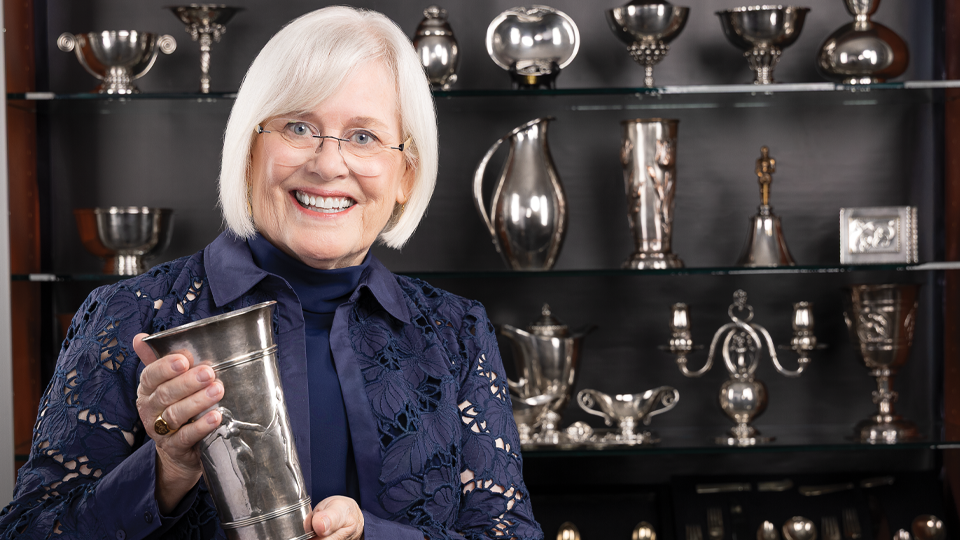
Shelly Culea holding a piece from the MATC's sliver collection.
There was a time when people served meals on exquisitely crafted china, drank from finely cut crystal glasses and ate with handwrought, gleaming silverware. “We used to find in our hearts and in our souls a love of fine art,” said Shelly Culea, a Mequon resident, silversmith, jewelry maker and artist. “Life moves fast today. I understand that we cannot live in the past. The best we can do is protect its treasures.” For nearly 20 years, Culea has been doing just that, polishing, promoting and protecting as volunteer curator of MATC’s silver collection. Housed at the Downtown Milwaukee Campus, the collection contains 65 pieces and includes handmade sterling silver tea cups, chalices, flatware, candy bowls, candle holders, candle snuffers, vases, spoons, pitchers and jewelry.
The pieces, some of which are more than a century old, were crafted by Emil F. Kronquist, an original faculty member of the Milwaukee Continuation School, which eventually became MATC, and world-renowned Danish silversmith Georg Jensen. Also in the collection are several instructional panels that Kronquist made to demonstrate how to craft items. Kronquist retired in 1951 and donated his collection of silver pieces and instructional panels to the college in 1959. The story of the collection forever entwines Kronquist, MATC and Culea. And like all good stories about priceless historical artifacts, it includes traces of mystery and intrigue. It’s a tale of gifts made and treasure buried, rediscovered, lost again and then gloriously restored.
Hidden treasure
For two decades the collection was displayed in a classroom at the Downtown Milwaukee Campus where the public could freely come and admire it. That all changed in the late 1970s, when brothers Nelson and William Hunt, billionaires from Texas, attempted to corner the global silver market and sent the price of the metal to what was then an all-time high of nearly $50 per ounce. On high alert that someone might snatch the Kronquist collection and turn it into cash, MATC shuttered the gallery and stored the collection. No one would lay eyes on it for almost two decades. The Kronquist collection reappeared in 1997 when put on display at Villa Terrace, a decorative arts museum in Milwaukee. Culea attended the show and was awed. “That show made quite an impact on me,” she said. “It was simply magnificent.” After three months at Villa Terrace, the collection once again disappeared. More than a decade went by. One day in 2009, Culea found herself in the president’s office at the Downtown Milwaukee Campus. On a whim, she asked the assistant if she had ever heard about the college’s silver collection. The assistant led Culea into the darkened office of the president. Without switching on any lights, she led her into the private bathroom attached to the office. There, she opened a wooden closet and began to move folded towels and other linens. Behind the stacks of cloth shone almost every piece of the Kronquist collection. “I was completely stunned,” Culea said of the discovery.
“Some things are worth saving and this collection is one of them. It’s priceless.”

Preserving the collection
Culea quickly offered to become the curator of the collection. Without formal museum training, she created the displays seen today in the MATC board room. “It’s a beautiful collection of artifacts by supremely talented artisans,” wrote Hazel L. Wheaton in an article published in Art Jewelry magazine in March 2011. Culea was especially taken with Kronquist’s instructional panels. “They are beautiful,” she said. “The effort Emil went through to teach students his craft was exquisite. You don’t see work like this anymore.” In 2014, the college had the collection appraised by Drucker Antiques, a New York firm that specialized in Georg Jensen silver. Drucker catalogued and valued the collection at about $160,000. Today, with the price of silver reaching nearly $80 per ounce, it’s worth probably 10 times that, Culea estimated. Since 2009, Culea has polished all the relics once every two years.
She carefully uses Goddard’s Silver Foam to wash the pieces and a 100% cotton cloth to dry them. The process takes about four hours, she said. Culea polished the collection for the last time in April 2026. Now, at 76 years old, she is ready to hand over those duties to someone who shares her enthusiasm for the collection’s unique combination of artistry and history. “I have been thinking about leaving for a few years,” she said. “This represents a lost art, and I’m trying to keep it as front and center as I can,” she said. “It has been an honor for me to work with these treasures.” Elizabeth Schultz, senior executive assistant to the president and the MATC District Board, has worked with Culea for the past decade and also wants to see the collection remain relevant. “I believe we should care about our cultural artifacts,” Schultz said. The Museum of Danish America in Elk Horn, Iowa, has expressed an interest in adding the pieces to its collection of 35,000 artifacts. Ideally, Culea would love to see the college donate the collection to the Milwaukee County Historical Society Center, where it could be permanently on display and appreciated every day. “Some things are worth saving and this collection is one of them,” Culea said. “It’s priceless.”

Volunteer curator Shelly Culea keeps MATC’s silver collection shining.