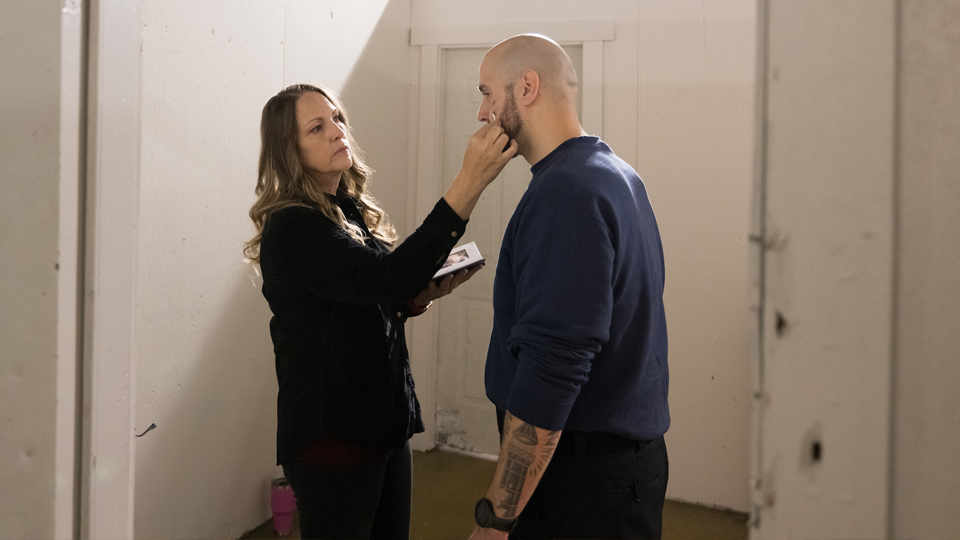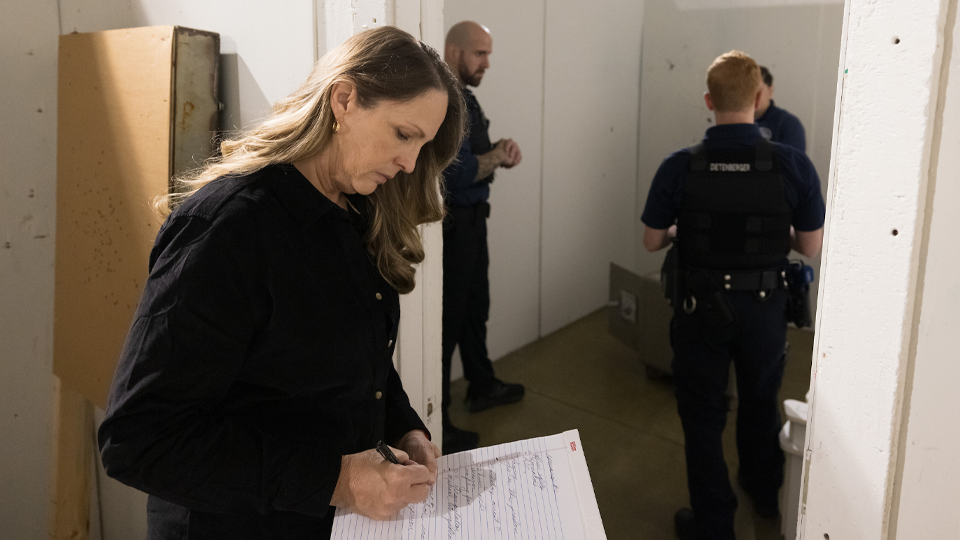


Former Milwaukee police detective Connie Prange brings her street smarts and experience to the Criminal Justice Studies classroom
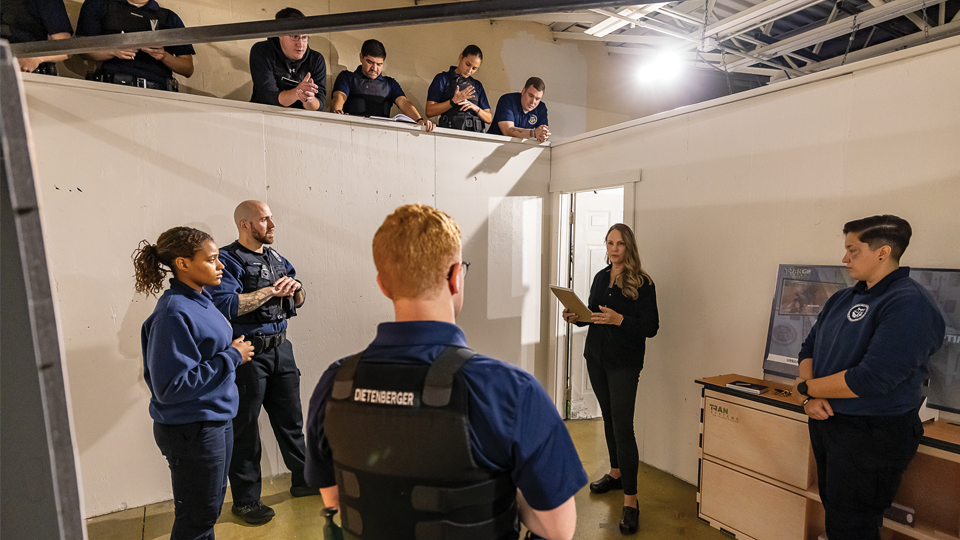
Connie Teaching Criminal Justice to new recruits/students
The wall was 6 feet high and had to be scaled in one try. There were no second chances. Getting over that wall was required to get into the Milwaukee Police Academy, a place 16-year-old Connie Prange was dreaming about attending back in 1984. “That wall was a physical and a mental barrier to becoming a police officer,” Prange recalled. “Most people run up to it and stop. You have to keep going. I’m a pretty determined person. I was prepared to do what it took.” Prange scaled the wall and never stopped showing her determination: first by serving as a Milwaukee police officer and detective for 15 years, and then by training the next generation of law enforcement personnel as lead instructor in MATC’s Criminal Justice Studies program for the past 22 years. As lead faculty and instructional chair, she teaches courses in the Criminal Justice Studies associate degree program as well as police academy recruit classes at the Oak Creek Campus, imparting knowledge amassed during her years of service. “I believe MATC’s instruction is right on point because instructors bring real-world experience and keep up with current trends in the field,” she said. “We try to give them a realistic view of the job.”
Prange’s determination, along with her dedication to physical fitness and mental wellness, helped her navigate the dark world of violence, brutality and depravity she encountered on the job, and the mistrust some people had with the police. “People who are doing this job have a calling to do it. It’s not a job for everyone,” she said. “It used to be very competitive to get this job, but now departments are having a hard time finding people, and I can understand why. For me, it’s been a fantastic career.”
“People who are doing this job have a calling to do it.”

Over the wall
Prange grew up in Miami, Florida. Her mother raised her and three brothers alone. Her father wasn’t in the picture. “I grew up pretty poor. We were in and out of homelessness,” she said. “So I always wanted to do something that had a measure of financial security.” The family moved to Milwaukee when Prange was in the eighth grade. She lived on the city’s North Side. As a high school junior, she saw an eye-opening presentation about the Milwaukee Police Department’s Police Aide program. The work seemed interesting; she could attend college classes and could eventually land a secure job. She was hooked. “I pretty much decided right there and then that I was going to be a police officer,” she said. She graduated high school in June 1984 and started as an aide in January 1985. For three years, she worked in the identification division, taking fingerprints, checking records and visiting the medical examiner’s office. “I got to see what the job was really like,” she said. “For me, everything went very smoothly. I felt respected.
I believe the police officers there knew we were an asset for them. To them, we were up-and-coming police officers.” She also attended police science classes at MATC, earning 30 college credits. In high school, she knew she would have to pass the written, oral and physical exams to get into the academy. So she started running and working out. She found a 6-foot wall in her neighborhood and practiced getting over it. Each day at 6 a.m., she jogged 3 miles to a gym, lifted weights, ran back home and went to school. The hard work paid off. She passed all the exams. She turned 21 in August 1987 and entered the Milwaukee Police Academy. “I was excited,” she said. “I was ready to get on the street.” Prange said there were about 30 students in her academy class, and perhaps four or five were women. “We were a tight group, but we weren’t exclusive,” she said.
Working undercover
She graduated from the academy in January 1988 and was sent to the city’s District 2, at Second Street and Lincoln Avenue. For six months, she worked third shift. In November 1988, she was told in a 3 a.m. phone call that the next day she would be working as an undercover narcotics officer. She was 22. “I didn’t really know what drugs were,” she said with a laugh. “I got a big suitcase full of pills and things that I had to learn. But there was a lot I learned on my own.” For two years, she worked undercover throughout the city, looking to buy drugs wherever she could. In houses. On boats. In alleys. Even at a dentist’s office. She wore wires. She developed informants. She carried wads of cash. “I was never afraid, but I probably should have been,” she said. “Some of this was extremely risky business.” In April 1993, at age 26, she passed the detective exam.
For the next eight years, she worked in narcotics, sensitive crimes and criminal investigation units. She processed horrific crime scenes, assisted traumatized victims and spent long hours tracking down perpetrators. “You have to understand your role, and your role is to help people,” she said. “I did what I could to do that the best way I could.” To keep her keel even, she ran, worked out, socialized with friends outside the force and started a family. In 2000, she went to law school and left the force. She earned her law degree from Marquette University in 2001 and spent time with her young children. In 2003, she took a teaching job at MATC and now serves as lead faculty and instructional chair of the program. She counsels students about how to be successful in law enforcement and how to handle the job mentally, physically and emotionally. “About 99% of policing is having good communication skills,” she said. “I tell them that what they do now matters. Police background checks are serious and extensive. I also tell them to take the physical part seriously. If you can’t do one push-up, start by doing one and build up.” Prange has no plans to leave the college. “I love mentoring students and people who are making career changes,” she said. “I still find this work interesting and rewarding.”