


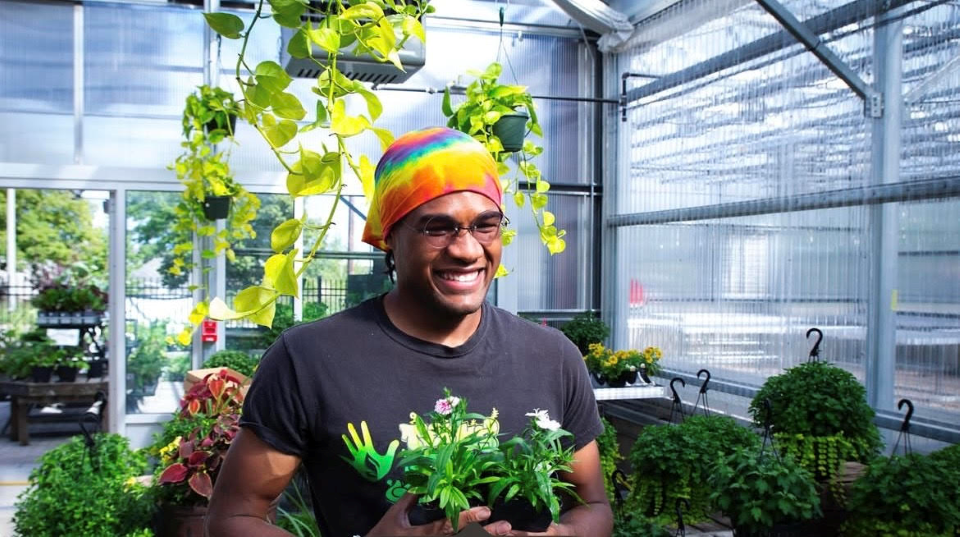
The Gap Year program really opened my eyes to a lot of career fields and to the city.

As a child, Tylon Moon constantly communed with nature.
Near his house where he grew up in Milwaukee was a grassy field where insects buzzed, wild grass and weeds thrived, birds chirped, butterflies flitted and small creatures scampered.
“I would spend so much time there just being with everything,” Moon recalled. “I considered it an ocean that was full of creatures. I would get lost in it.”
While in his ecological enthrallment, Moon, now a student in Milwaukee Area Technical College’s Landscape Horticulture program, discovered a true love: mushrooms.
“When I started to learn about soil science and mushrooms, that’s when I got really excited,” Moon said. “I love how much mushrooms contribute and impact our environment and how they are incorporated into almost everything that we do. I want to share that knowledge.”
He wants to open his own mushroom apothecary, selling edible mushrooms to gourmets and foodies as well as mushroom supplements. He also wants to work with firms that use mushrooms to remediate environmental mishaps, such as oil spills.
“When I talk about mushrooms, most people are intrigued,” Moon said. “Many people think that most of them are poisonous. To me, mushrooms are extremely useful, and the number of people who also think that is small but growing.”
Mushrooms consist of two main parts: the mycelium, which is the root system growing under the soil or in other organic matter, and the fruiting body, which grows above ground.
Mycelium can be combined with hemp and other natural materials to construct biodegradable coffins, create building bricks that can withstand tremendous amounts of pressure and fashion faux leather clothing. The fruiting bodies can be used in cooking, while psilocybin, a compound found in some variations of mushrooms, can be used to treat anxiety and depression.
Both parts, the mycelium and the fruiting body, can be used to break down, absorb and immobilize pollutants in soil, water and waste.
“The mushrooms bring in the insects. The insects bring the birds,” Moon said. “That’s how the environment is brought back to life and revitalized.”
Moon graduated from Pius XI Catholic High School in 2022. He was unsure about what to do with his life, so, on the suggestion of his aunt, he signed up for the MATC Gap Year program, which provides high school graduates uncertain of their future with career and educational opportunities.
“The Gap Year program really opened my eyes to a lot of career fields and to the city,” Moon said.
Right before joining the Gap Year program, Moon secured an internship with Teens Grow Greens, a community group that connects promising student leaders to environmental, horticultural and agricultural opportunities.
He quickly blossomed from an intern to a board member to a staff member. In January 2024, he became the greenhouse coordinator at Webers Greenhouse, a longtime family-operated garden center on North Green Bay Avenue. Teens Grow Greens purchased the greenhouse in 2018.
“He is such a valuable asset to Teens Grow Greens and a model and mentor for the teens we currently employ,” said Charlie Uihlein, founder and executive director of the organization. “We are so lucky to have Tylon as part of our community.”
After completing the Gap Year prorgram, and with the experience of Teens Grow Green under his belt, Moon enrolled in MATC’s horticulture program, based at the college’s Mequon Campus.
“The greenhouses are state of the art,” he said, “and I’m learning exactly what I need to succeed at Webers.”
He recently instituted an integrated pest management (IPM) program to solve the greenhouse’s pest problems, weeks after learning about IPMs at MATC. “In the past, our peppers were just devastated by aphids,” Moon said. “Not anymore.”
Moon recently won the John Tomasovic, Sr. Scholarship from the American Floral Endowment, a national group that funds floriculture research, scholarships, internships and grants. The Tomasovic scholarship is awarded to students with financial need and an exemplary grade point average.
Moon clearly has a passion for the field, said Joe Dietz, one of Moon’s instructors and the lead faculty in the Landscape Horticulture program.
“He is truly interested in the class topics, asks relevant questions, and really wants to learn the material,” Dietz said.
“He is also a very participatory student who attends school field trips, attends horticulture club activities, and helps with school plant sales,” Dietz added. “He’s friendly and always willing to help.”
Moon is making steady progress toward his degree. He works full time at Webers, so he takes one or two classes each semester. After he earns his associate degree, he plans to transfer to the University of Wisconsin-Milwaukee’s Conservation and Environmental Science program.
Moon is also active in the Wisconsin Mycological Society, a nonprofit, volunteer-run organization that offers mushroom education, foraging trips, cooking and preservation tips, and home cultivation suggestions.
“MATC has given me a world of real experience,” Moon said. “I’m excited that they are preparing me to do something I absolutely love.”
About MATC: Wisconsin’s largest technical college and one of the most diverse two-year institutions in the Midwest, Milwaukee Area Technical College is a key driver of southeastern Wisconsin’s economy and has provided innovative education in the region since 1912. More than 35,000 students per year attend the college’s four campuses and community-based sites or learn online. MATC offers affordable and accessible education and training opportunities that empower and transform lives in the community. The college offers more than 180 academic programs — many that prepare students for jobs immediately upon completion and others that provide transfer options leading to bachelor’s degrees with more than 45 four-year colleges and universities. Overwhelmingly, MATC graduates build careers and businesses in southeastern Wisconsin. The college is accredited by the Higher Learning Commission.