



There is a recognition by the students that education like this is a way of getting out of where they are and making a better life for themselves.

Don Schell simply can’t sit still.
While working as a traffic systems engineer for the Wisconsin Department of Transportation, he became a part-time instructor in Milwaukee Area Technical College’s Electronic Technology-Automation program in 2015.
Even after he retired from his state job in 2024, the restlessness remained.
He tried traveling. He went camping and hiking in Ireland with his brother. He spent another week on the Caribbean island of Saint Martin, lying on the beach.
Neither expedition excited him.
“There I was, sitting by the ocean, and after about five minutes, I was wondering what I was going to do next,” he recalled.
What came next was Schell deciding to work while at play. In 2025 he discovered Volunteer Vacations, where participants pay a nominal amount for room and meals, and in return, serve in places around the world that need assistance.
“I had a vague idea I could help by teaching STEM classes,” he said.
So that’s how Schell, on New Year’s Day 2026, found himself boarding a plane headed for Nairobi, Kenya, to work in Kibera, the poorest area in the country and the largest slum in Africa.
Landing in a different world
Simply reading about Kibera is sobering.
Located about 4 miles from the center of Nairobi, Kibera has between 750,000 and 1 million people living in 1 square mile of land.
Diseases caused by poor hygiene are prevalent. More than 10% of the population has HIV. Most people living there have no access to fresh water and electricity. The average Kibera resident makes about $2 a day, according to the French Institute for Research in Africa. Assault and rape are common. Dirty sewage seeps openly through the area.
“The smell overwhelms you,” Schell said. “Nairobi is a very modern city, and this area of unbelievable poverty sits right next to beautiful golf courses and resorts. Sometimes only a thin wall separates those two things. It’s extraordinary to see that. Nothing in this country matches that level of poverty.
“I researched everything before I went, so I knew what I was getting into,” he added. “But it still is a culture shock. You go there with uncertainty, but you are ready to do what needs to be done.”
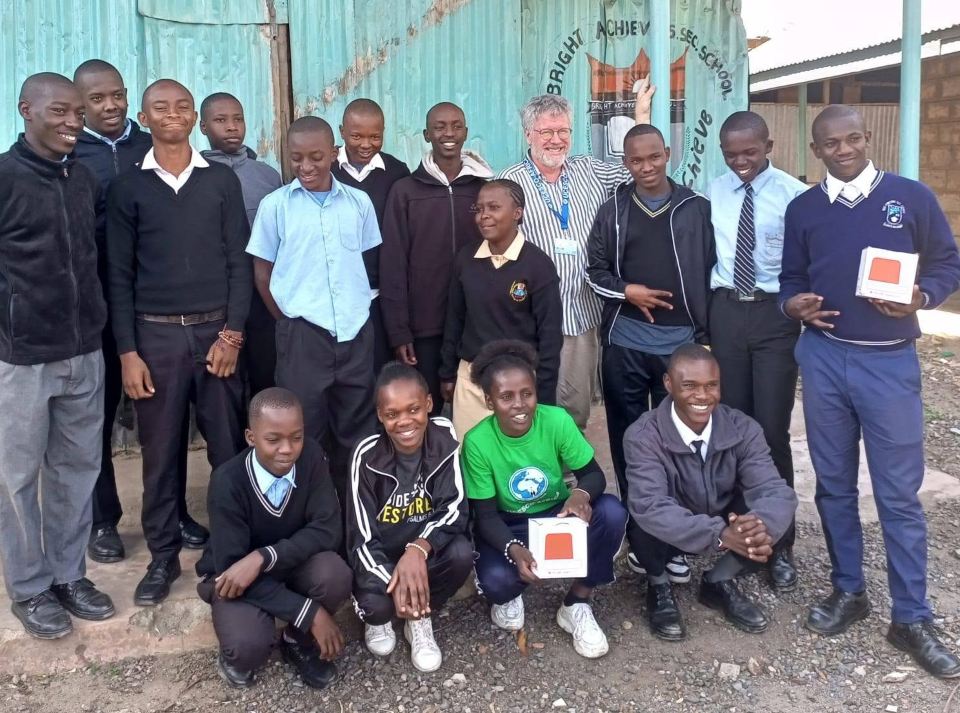
For Schell, that was teaching high school students the principles of physics, electricity, electromagnetics, basic robotics and other science classes at Bright Achievers High School, a private school operated by United Cultural Empowerment and Social Community Organization-Africa (UCESCO-Africa), a non-profit organization that empowers underserved communities through education, healthcare, youth development, women’s empowerment, environmental conservation and community development.
Making an impact
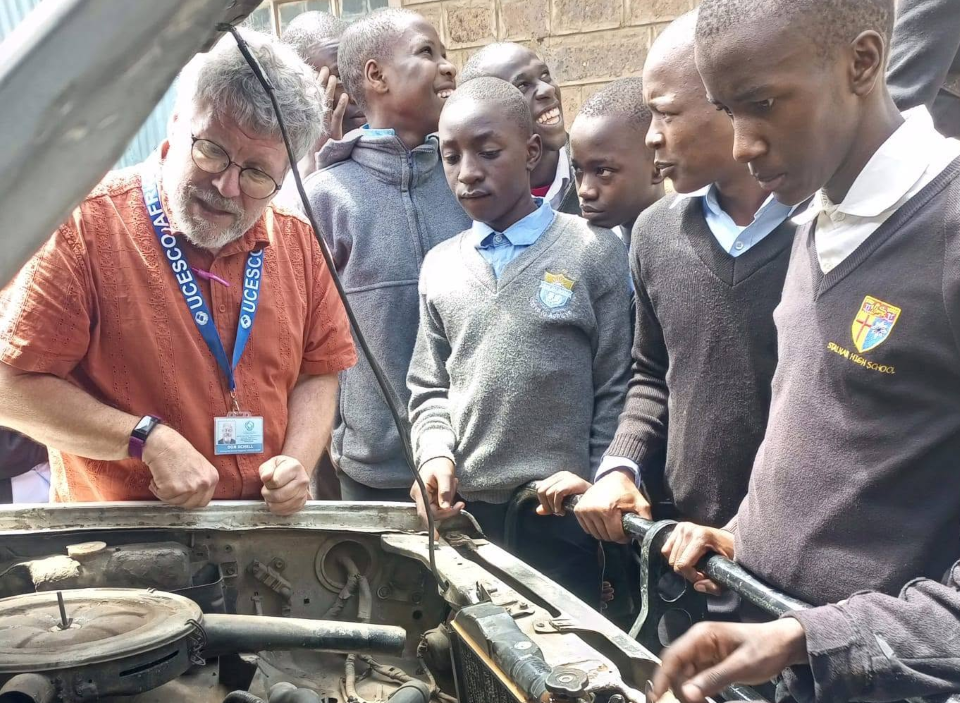
Schell and the other volunteers lived a few miles from Kibera. Each weekday they were driven to the school and worked from 9 a.m. to 2 p.m. Schell’s lessons combined theory with practical, hands-on activities, which helped the students better understand scientific concepts, Schell said. He also helped the students prepare for a battery of highly competitive national exams that determine who attends college and who receives scholarships.
“The students were incredible,” Schell said. “They were smart and excited to learn. They were very engaged. Many of them absorbed everything.”
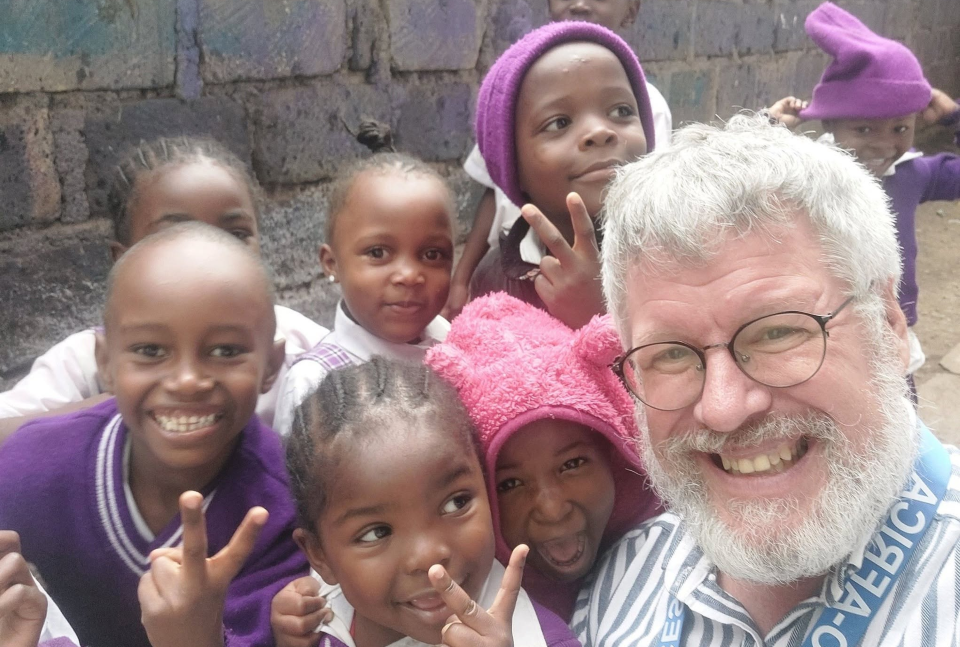
One student named Elvis loved computers. “He jumped right in,” Schell said. Another student, in middle school, convinced Schell to teach a few lessons to younger students.
On the weekends, the volunteers could travel on their own. Schell went on a safari and visited several museums in Nairobi. One weekend he volunteered at a UCESCO medical camp in Mombasa. To reach it, he took a train across the country. He worked at the camp and marveled at the Indian Ocean.
At the end of his two weeks in January, he felt exhilarated. “I knew before I left that I was coming back,” he said.
And he did. He returned to Kibera in July and stayed for nearly a month.
“It was an even better experience the second time I went,” Schell said. “I felt so much more connected, more accepted, more prepared. I had developed friendships and got to continue them.”
He also brought with him a slew of scientific instruments, including some basic electronics, optics, springs, microscopes and beakers. “I did get a few looks from the security people when I landed at the airport with those,” he said.
Schell also decided to help transform an unused, two-story ramshackle building in the middle of the school’s campus into a laboratory for teaching physics and chemistry on the first floor and a library on the second level.
He began a GoFundMe campaign for the project, which entails tearing down the existing building, pouring a new foundation and erecting a new structure. Once completed, the laboratory will provide students a permanent space to conduct experiments, deepen their understanding of physics, and, hopefully, inspire future engineers, scientists and innovators, Schell said.

“There is a recognition by the students that education like this is a way of getting out of where they are and making a better life for themselves,” he said.
Back at home, Schell talks to family, friends and community groups about donating to the effort.
“These projects are an opportunity to have a real impact with small amounts of money,” he said. “I like to tell people that they don’t have to give huge amounts. The small amounts really help. Every bit helps.”
Making an impression
Schell’s efforts have not gone unnoticed. He has made a significant and lasting impact on the Kibera community through his dedication, expertise and generosity, said Edna Okello, volunteer coordinator for UCESCO-Africa.
“Don’s commitment to empowering young people through education and his willingness to share his expertise have made a meaningful difference in the lives of many students,” Okello said. “His contributions truly reflect the values of innovation, leadership, service and community engagement.”
Schell’s boss at MATC — Dr. Michael Jenkins, dean of the college’s STEM Academic and Career Pathway — equally admires and respects Schell’s efforts.
“Don’s outstanding volunteer service is an inspiring example, and I hope it will encourage other members of our STEM Pathway,” Dr. Jenkins said. “There are many opportunities for engineers and other professionals to share their knowledge, skills and experience.”
Schell plans to return to Bright Achievers in 2027. He wants to complete the laboratory and library project. He also wants to install solar panels at one of UCESCO-Africa’s medical facilities so it doesn’t have to rely totally on electrical power. At some point, he’d like to stay in Kibera for an entire semester.
Making such an investment, especially for people looking forward to retirement after working for decades, might not work for everyone, Schell admitted, but it’s working well for him.
“I just want to give back,” he said. “I just want to help and doing this makes me feel that I am.”
About MATC: As Wisconsin’s largest technical college and one of the most diverse two-year institutions in the Midwest, Milwaukee Area Technical College is a key driver of southeastern Wisconsin’s economy and has provided innovative education in the region since 1912. More than 35,000 students per year attend the college’s four campuses and community-based sites or learn online. MATC offers affordable and accessible education and training opportunities that empower and transform lives in the community. The college offers more than 180 academic programs — many that prepare students for jobs immediately upon completion and others that provide transfer options leading to bachelor’s degrees with more than 45 four-year colleges and universities. Overwhelmingly, MATC graduates build careers and businesses in southeastern Wisconsin. The college is accredited by the Higher Learning Commission.