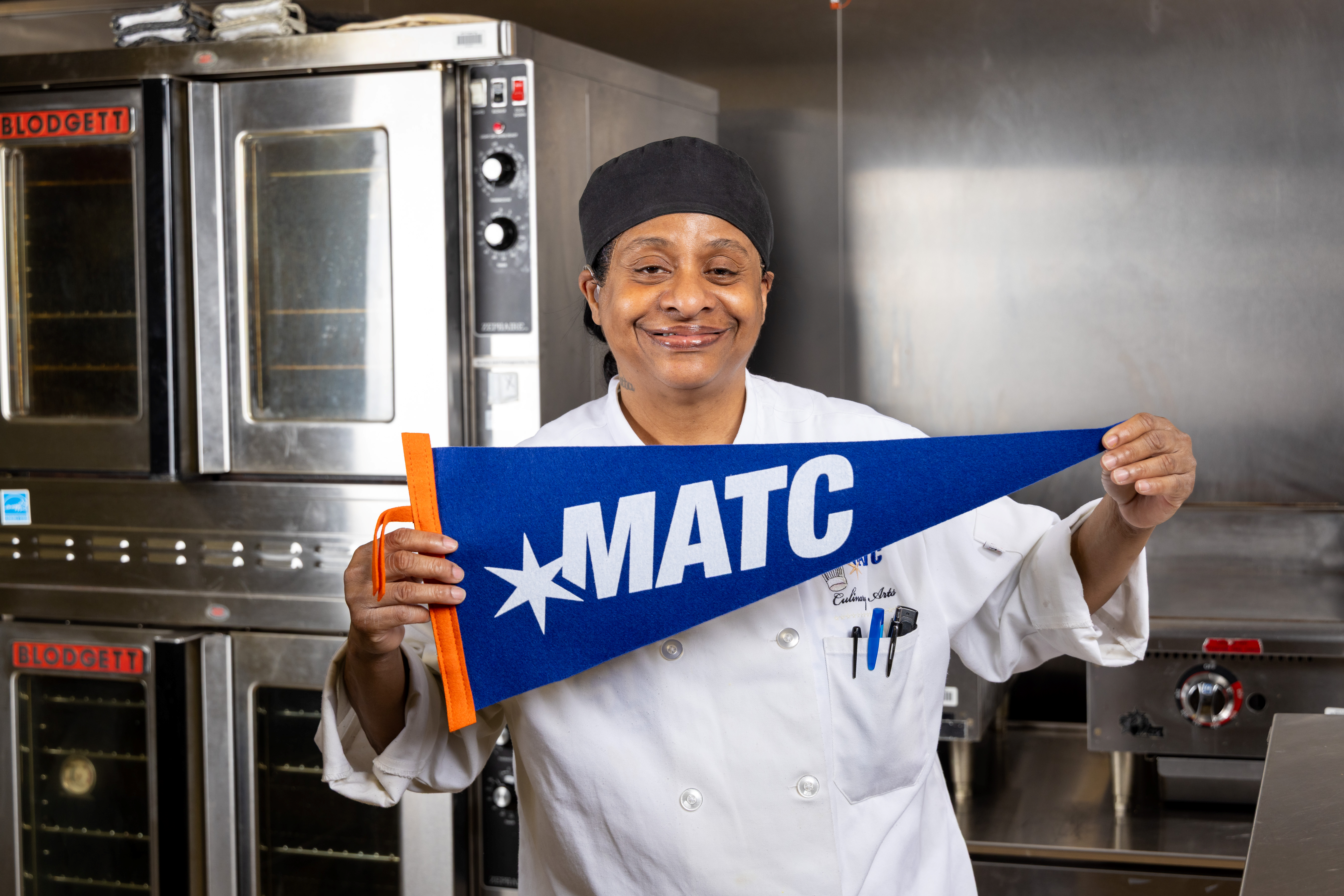



It has been a slow journey for me. But once I decided that this is what I wanted to do, I accepted the path and went for it. I wasn’t going to ever give up, and I never did give up.

When Channetta Winfield was growing up, the kitchen was her happy place.
There she eagerly assisted her grandmother and mother as they whipped up Jamaican dishes, Southern comfort food, soul food and African recipes. They made everything from scratch, using all natural ingredients.
“My family was centered around cooking, eating and entertaining,” said Winfield, who was born and raised on Chicago’s South Side. “Someone was always cooking something.”
For Winfield, the kitchen also was a quiet place.
Winfield was born deaf, the result of her mother contracting German measles while pregnant.
But that has not stopped Winfield from following her passion for all things culinary. This month, Winfield will graduate with an associate degree in Culinary Arts from Milwaukee Area Technical College. She will celebrate her achievement May 16 at the 2026 Spring Commencement ceremony and proudly receive the degree that took her four years to finish.
“It has always been my goal to become a professional chef,” Winfield said through a sign language interpreter. “Watching my grandmother inspired me. My mother went through the culinary program at MATC more than 30 years ago. She told me to attend MATC and make my dream a reality. She always told me to never let anything stand in my way.”
Learning how to learn
Growing up in Chicago, Winfield attended what she called an “oral” school, a place where deaf and hard-of-hearing students were discouraged from using sign language, she said.
At home, she communicated with her family through a combination of speech reading, lip reading and rudimentary sign language. When she was 12, Winfield was sent to a mainstream school where she learned American Sign Language.
Her family moved to Milwaukee when she was 15. She attended the now-closed Burroughs Middle School on North 80th Street, a place that used sign language, had interpreters, and other deaf and hard-of-hearing students.
“It was the first time I had been around other deaf and hard-of-hearing students, and it was nice to socialize with them,” Winfield said.
She attended Milwaukee’s John Marshall High School for two years, moved back to Chicago for one year, then returned to Milwaukee and graduated from Marshall in 1990.
“After that, I had to figure out what I wanted to do with my life,” she said.
She placed her culinary dreams on hold as she raised six children. Today, she has 10 grandchildren.
Going back to school
As her children grew up and started their own lives, Winfield thought more about attending college. “I was hesitant to try it,” she said. “I had no idea what to expect. The very first class I had was a little awkward for me.”
That first class was a culinary fundamentals course with instructor Brian Quinn.
“You get into class and you think you know everything already, but you quickly find out that you don’t,” Winfield said. “Many of my classes weren’t easy. But I was a dedicated student. I never missed a day. I always tried to get to class early. As I learned more and more, I discovered that this was something I could do and something I could flourish at.”
Winfield consistently demonstrated a strong work ethic and a steady, reliable approach to every task, Quinn said.
“She didn’t hesitate or stall once she began an assignment. She simply moved with purpose, completed the work and moved forward again,” he said. “She is, in every practical sense, a cook in the best meaning of the word.”
At first, most students were fascinated by how Winfield took instruction, said Jodie Nigro, who served as Winfield’s sign language interpreter in many classes. Once the novelty wore off, Winfield became one of the group, and her determination and diligence impressed her classmates.
“Because she was such a good student, she became an inspiration for her classmates,” Nigro said.
Winfield said she always felt welcomed and accepted by her classmates and instructors. “I never, ever felt inadequate,” she said. “I never felt that any of the other students looked down on me. I never felt discriminated against. The instructors certainly didn’t ease up on me. They raised the bar high for all of us.”
She finished her classes on a high note, earning academic honors. She also became a leader and role model on campus. She served as president of the college’s Deaf Culture Club, which helps students learn, practice and use sign language in everyday conversations. In August 2025, she shared her story with 1,500 MATC employees at the Academic Year Kickoff, a two-day event to celebrate the start of the Fall 2025 semester.
“We want to provide every student an education that connects them to their dreams,” MATC President Dr. Anthony Cruz said at the event.
Realizing her dreams
With her degree in hand, Winfield said she will cook at her mother’s catering business and someday plans to open her own food truck.
“A business owned by a deaf and hard-of-hearing person would be a great example for the community,” she said. “We have deaf pilots, deaf doctors, deaf truck drivers. Why not a deaf food truck owner?
“It has been a slow journey for me,” she added. “But once I decided that this is what I wanted to do, I accepted the path and went for it. I wasn’t going to ever give up, and I never did give up.”
She received amazing support at MATC, she said. “All of my instructors were wonderful, the students were great and the Student Accommodation Services people were great,” she said. “They all helped me be the independent person I needed to be to do this. I tell everyone I can that they can do anything they want to do. They’re not alone. There are people here who will support them.”
Learn more about MATC’s Culinary Arts program
About MATC: As Wisconsin’s largest technical college and one of the most diverse two-year institutions in the Midwest, Milwaukee Area Technical College is a key driver of southeastern Wisconsin’s economy and has provided innovative education in the region since 1912. More than 35,000 students per year attend the college’s four campuses and community-based sites or learn online. MATC offers affordable and accessible education and training opportunities that empower and transform lives in the community. The college offers more than 180 academic programs — many that prepare students for jobs immediately upon completion and others that provide transfer options leading to bachelor’s degrees with more than 45 four-year colleges and universities. Overwhelmingly, MATC graduates build careers and businesses in southeastern Wisconsin. The college is accredited by the Higher Learning Commission.