


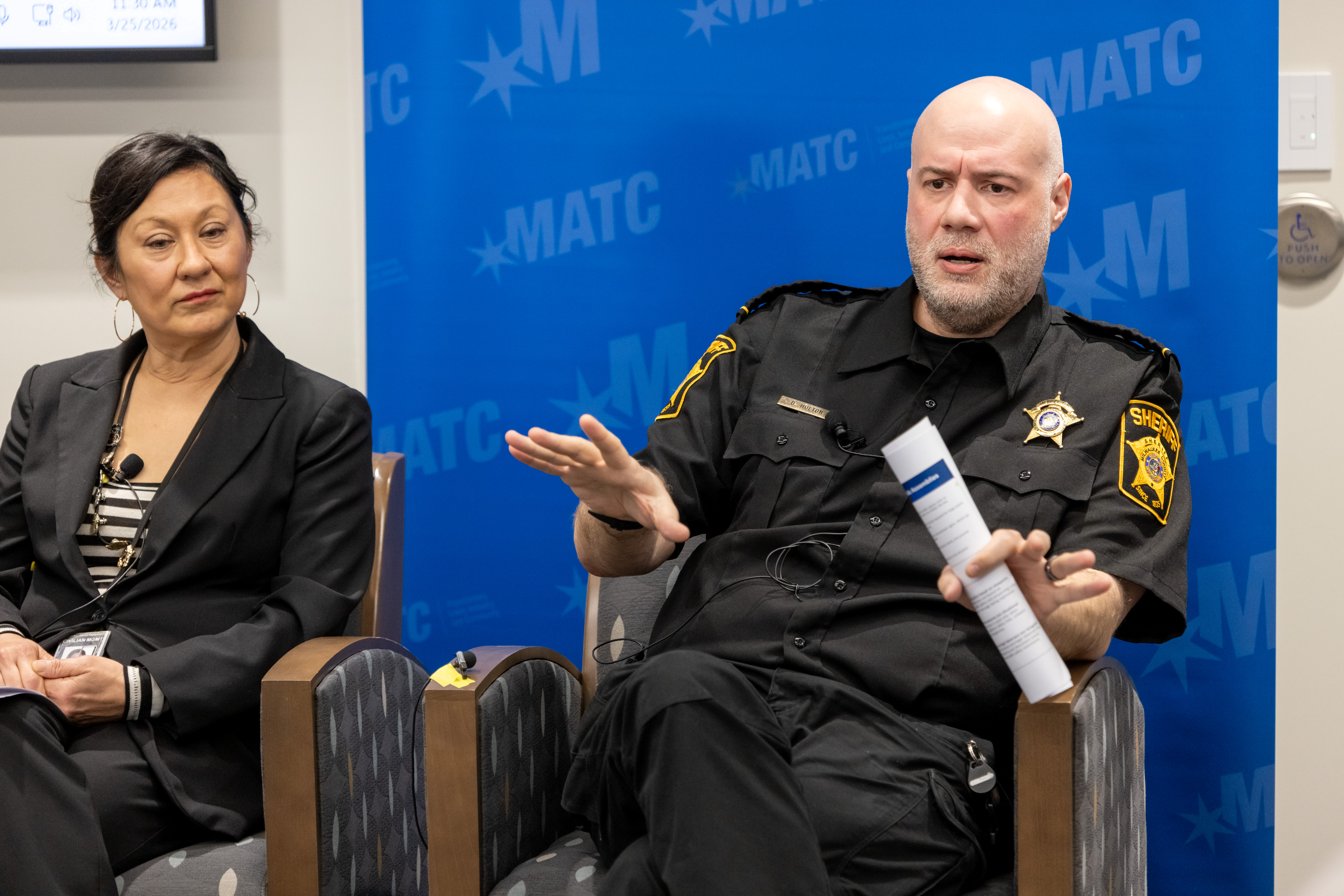
I believe all of us -- MATC, the sheriff's office and the police department -- are working well together. We collaborate all the time.

Keeping Milwaukee Area Technical College safe and secure is a team effort, and MATC students, faculty, staff and outside law enforcement officials all must understand their parts.
That was the message from MATC Public Safety and representatives of the Milwaukee Police Department and the Milwaukee County Sheriff’s Office on Wednesday, March 25, at a forum hosted by MATC’s Public Safety department, led by Chief of Public Safety and Risk Management Aisha Barkow.
 Barkow, along with Milwaukee County Sheriff’s Office Inspector Douglas Holton and Milwaukee Police Department Chief of Staff Heather Hough, discussed how MATC students and staff should respond to local, state and federal law enforcement—including the Department of Homeland Security (DHS) and Immigration and Customs Enforcement (ICE)—on campus.
Officers from any level of law enforcement can access MATC’s public spaces, said Shari Rowe, the college’s emergency manager in Public Safety.
But these departments need a warrant signed by a judge, called a judicial warrant, to access nonpublic spaces, such as private offices, meeting rooms, and lecture halls and classrooms in use, Rowe said. That rule can be bypassed in emergency situations like fires or active shooters, she added.
Many federal agencies, including ICE, use administrative warrants, which are signed by an immigration official rather than a judge. These warrants do not grant authority to enter nonpublic campus spaces without consent.
Without a judicial warrant, even if ICE presents an order of removal or deportation for a campus community member, an institution is not legally required to grant ICE access to nonpublic campus spaces or assist in apprehending an individual.
The college also protects the privacy of student records under the Family Educational Rights and Privacy Act (FERPA), Rowe said. Again, law enforcement must produce a judicial warrant to access these records, she said.
Rowe encouraged students and staff to know their rights as outlined on the college’s website.
Dealing with federal immigration officials has become a “touchy subject,” Holton said. “Immigration is not our role,” he said. “We respond only to judicial warrants.”
Hough agreed. “We are not in the business of civil enforcement,” she said. “We cooperate with federal agencies for someone wanted for violent crimes. But if we respond to a situation, we cannot obstruct the investigation or the action being taken.”
Holton urged anyone confronted by immigration agents on campus to document the interaction as much as possible. “I have no issue with people using their cellphones to document these encounters,” he said. Also, MATC Public Safety officers, Milwaukee police officers and sheriff’s deputies all carry body cameras.
The police department and sheriff’s office are working to build trust with the community and the college by hosting events every month to engage residents and striving to be respectful and efficient if they are called to MATC.
“The response depends on the situation, but we always want to be as professional as possible,” Hough said. “We want any interactions to be carried out in a peaceful and cooperative manner.”
Learn more about MATC Public Safety
About MATC: As Wisconsin’s largest technical college and one of the most diverse two-year institutions in the Midwest, Milwaukee Area Technical College is a key driver of southeastern Wisconsin’s economy and has provided innovative education in the region since 1912. More than 35,000 students per year attend the college’s four campuses and community-based sites or learn online. MATC offers affordable and accessible education and training opportunities that empower and transform lives in the community. The college offers more than 180 academic programs — many that prepare students for jobs immediately upon completion and others that provide transfer options leading to bachelor’s degrees with more than 45 four-year colleges and universities. Overwhelmingly, MATC graduates build careers and businesses in southeastern Wisconsin. The college is accredited by the Higher Learning Commission.